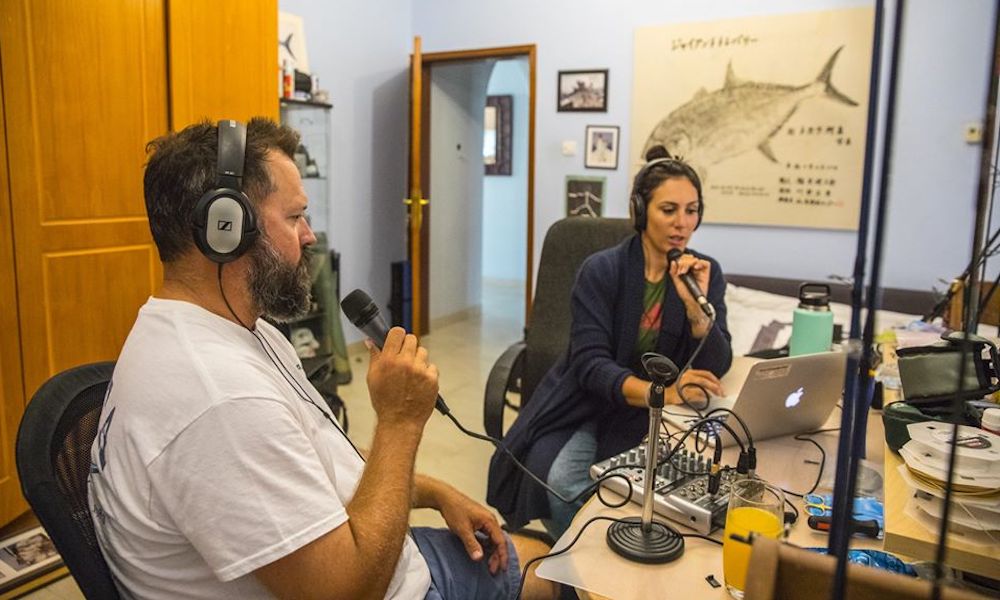
Sometimes, it’s hard to believe that ten years have passed since I first started the Anchored podcast. It was never my intention to begin an audio series, but fate had other plans. The podcast emerged and profoundly changed my life in ways I hadn’t anticipated. Maybe I was young and impressionable, or perhaps I had lost some faith in the good within the fly fishing community. Either way, the show arrived at just the right moment.
When recently asked me to share a few of my favorite episodes, I expected it to be a struggle. With over 250 episodes of storytelling and some of the most inspiring people I’ve ever met, I scrolled through my list of guests to see who stood out.
I was surprised to find that it wasn’t the usual candidates—entertainers, motivators, educators—rising to the surface. What actually stood out was intimacy. I know, I know, I’ve got some explaining to do and I better do it quickly.
One spring day in a California parking lot, I found myself sitting at an awkward angle, facing renowned artist and angler Russell Chatham. We had just met moments before, and there we were, like two sardines trying to decide who should lean into the mic first. I broke the silence by sharing news of my unannounced pregnancy, and he followed my lead with a trusted tale of his own. There’s something about shared air that makes shared secrets feel less vulnerable.
Russell has since left us, leaving behind his story and art, but for some reason, that simple memory of two strangers connecting stayed with me as I reviewed the list. Stories from guides, writers, business owners, fellow podcasters… yet my favorite episodes seem to be the ones with a fumble. The discomfort, uncertainty, even outright speculation from some guests, eventually warming to their curious host.
Once, I sat in Joan Wulff’s kitchen, quietly cursing the loud hum of the fridge as it eavesdropped on our conversation and loomed over my sensitive microphone. For me, Joan was the guest of all guests—a woman I admired and aspired to be like. Her grace, class, poise, and talent seemed so natural, so effortless. Sitting next to her, I felt like that clunky, obnoxious fridge.
Or Ted Juracsik, who didn’t want to be stuck in a room at iCast, presumably scheduled by the Tibor marketing team. His story is filled with heart-wrenching challenges and incredible feats, and the raw emotion he shared moved me deeply, as it did anyone who had the privilege of hearing about his dark and shocking past. Watching Ted unfold his crossed arms was one of the highlights of my interviewing career.
Selfishly, my favourite episodes are the ones that have helped shape me into the person I am today. I’ve heard the same from listeners—that an hour of wisdom from someone entrusting us with their advice does wonders for many of our souls. I can’t tell you how many times I’ve finished an interview, sat in my car, and cried, or hung up a call and rushed to my family for a hug. Perspective, it seems, can indeed still be found in long-form conversation.
WIth that said, here are my top three favourite interviews (if I had to choose):
I’d been a fan of Burkheimer rods for years before ever owning one. Wealthy clients would fly in with them on the old lodge Beaver. Off-grid steelhead alongside a classic vintage “Burky”. Luxury at its finest, Marilyn can keep her diamonds.
Kerry Burkheimer was a name I heard often and a brand I referenced regularly, but I’d never met the man himself. As creepy as it sounds, I can confidently say I thought of Kerry Burkheimer for at least one minute a day every day when I used to guide on the Dean. That’s 60 days straight, five years in a row on the Dean river. You can do the math. So, imagine my surprise when we finally sat down for our interview in Oregon, and he starts the episode with, “I’m really not very interesting”. Sputter, sputter, spew. What!?
This man—or at least his rods—had been the star feature in fisheries around the world. From Atlantic salmon in Russia to every high-end fishing lodge in the Pacific Northwest, Burkheimer’s name was a regular part of weekly dinner conversations. It had never occurred to me that Kerry himself might not be aware of his own popularity, as he worked tirelessly at his humble factory in Bend.
“Everyone has a story, Kerry”.
With that, his eyes transformed from bored and busy to keen and enthusiastic. As he spoke, he revealed a fascinating and inspiring past, filled with character and perseverance. Watching him recall why he is so impressive served as a powerful reminder for me. This is why I do the podcast.
On the subject of guests in Oregon, I must mention Frank Moore, whom we lost in 2022. As I sat at his kitchen table, I felt uneasy about the logistical challenge of two people using one microphone. His wife, Jeanie, had joined him for the episode, which I hadn’t anticipated. Navigating my questions to avoid confusion or blended audio tracks, I found myself watching more than talking.
Jeanie squeezed Frank’s hand and Frank gazed at her lovingly. With nearly 200 years of knowledge between them, I learned more about marriage in those few short hours than any couples therapy could ever teach.
Then there was Meredith McCord. I didn’t expect her to top my list—not because of who she is, a dear friend of mine, but because I usually find my favourite conversations with people at least twice my age. However, Meredith doesn’t do anything halfway, and that includes preparing for an interview. When we met up at the Denver trade show for our scheduled podcast, she rolled in and and handed me a printed timeline. I raised an eyebrow. If you know Meredith, you’ll recognise the subtle humour that accompanies her. Whether intentional or not, I find her extremely entertaining.
Admittedly, I thought I knew most of Meredith’s story, but looking back now, much of what I thought I knew about her was just that—assumption. As we walked through her early entrepreneurial days as pottery shop owner to her present role as an IGFA record chaser, she surprised me at every turn and detour. It was the perfect story arc; I laughed at the highs and leaned in during the climactic events, even uncovering a twist when I realized that our stories overlapped. She drove it home with a heart-warming conclusion that had us both in tears. Meredith McCord had just taken me through the perfect chronicle.
Like many of my interviews with friends, I struggle with navigating off-the-record courtesies and pivotal moments in their timelines. Knowing too much can create a tricky balancing act of prodding and discretion. At times, I’m entrusted with the whole story, followed by the vague suggestion to edit where I see fit. “I trust you,” they say.
Such confidence carries the pressure of keeping the storyline aligned to my integrity, but also to the comprehension of my listener. Maintaining the flow through lengthy omissions can come across as disjointed if I’m not careful with each segue. There are no second takes or handy voiceovers, and you only get one intermission break for a jolty transition. As a result, much of my communication is done with my eyes, often giving the ‘ol “I know, you know, but we don’t all need to know”.
This was partly the case during my first and favourite interview with the late Lani Waller. Lani and I were friends before we sat down to record. However, in this instance, we weren’t recording for Anchored; we were filming for a television series, complete with a full camera crew. Lani was a beautifully complex person with a story as deep and jaw-dropping as they come. A worldwide star, a steelhead authority, and the sole survivor of a plane crash, he had much to share and I didn’t want to push him. I tread carefully and listened as a pupil.
He had opened up to me, shared his story, and trusted me to guard it for future generations. Imagine my dismay when ninety minutes of sheer compassion and faith were edited down to just seven. So, I rolled up my sleeves, learned some audio software, and pulled his interview off the cutting room floor. And with that the Anchored podcast was born.
The show has remained focused on preserving history, and I hope it continues to do so long after I’m gone. Timelines will be archived, parallels drawn, and some may even find it useful for references and footnotes. What might not be as obvious is how many lives these remarkable individuals have touched, allowing not just me, but all of us, to honour their stories. With a kaleidoscope of backgrounds, each unique in its own way, it’s impossible to choose favourites—it’s the collection of them all that makes the series such a treasure trove of wisdom.