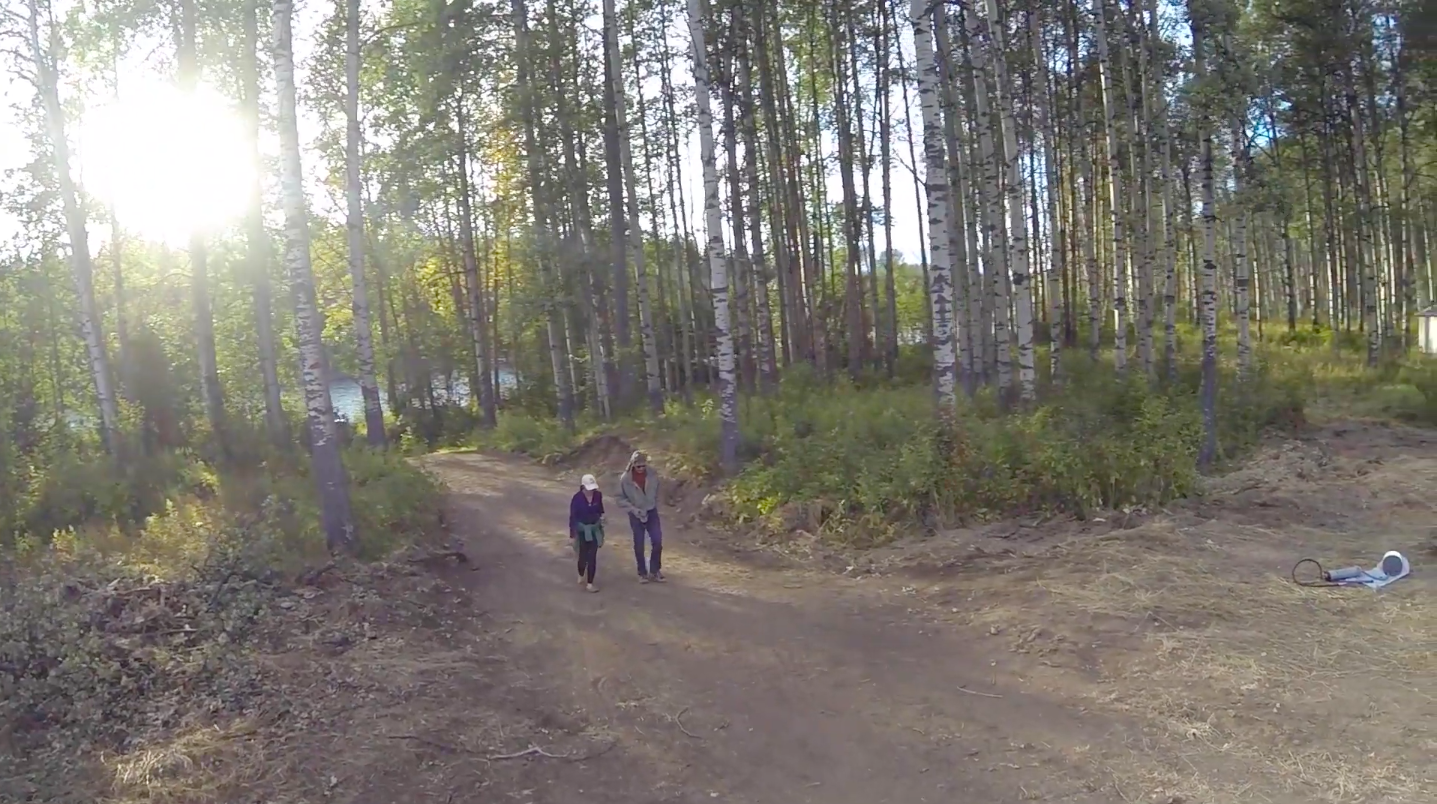
In the fall of 2014, we walked along my property line, discussing how the next few hours would unfold. Carefully, we stepped atop fallen yellow leaves that layered the ground like poplar pastry. I didn’t know it at the time, but I was about to interview a very nervous Lani Waller.
A Nervous Start
I can’t remember exactly how it started, but Lani and I had struck up a friendship a year earlier. It was during my guiding days on the Dean river—a place Lani knew well. In fact, it was through Lani and his old Scientific Angler tapes that I first learned about the Dean. Dated footage shows timeless glacial water framing a handsome man in a red bandana. His enthusiasm could sway even the most callous of men.
For months, I’d come off the water and settle into both my guide cabin and Lani’s emails. We’d exchange stories—mine from today, his from the past— but soon, our conversations grew deeper than fish reports and updates. Our relationship evolved, delving into philosophy, surviving accidents, death, life, and poetry.
Lani was a private person, and I’ll respect that here, but on that day at my place in northern British Columbia, he was finally ready to open up. His nervousness was understandable. In 2014, I hadn’t yet started my podcast, and we were about to sit down to record a segment for my television series, Shorelines.
Now, it was more than just me, Lani, and the steelhead. There was an entire crew—complete with a sound guy, drone pilot and cameraman. It was a stark contrast to our usual private correspondence, so we walked off our nerves before heading into the wall tent where the mics were waiting. Within minutes, we forgot about our audience, focusing instead on his story and the legacy he would eventually leave behind.
Roots of a Fisherman
Lani’s lifelong passion for fishing began at the age of six, in Missouri, shortly after World War II. It was 1946 when his father took him catfishing, and Lani caught his first fish—a small catfish. Little did he know, that simple moment would ignite a deep love for nature and fishing that would shape the rest of his life.
From then on, Lani fished frequently, catching catfish, crappie, and whatever else he could find in Missouri’s waters. With each outing, his belief grew stronger that fishing wasn’t just a pastime but a way to connect with the natural world—a way to belong to something larger than himself. This feeling only deepened when his family moved to California, where he discovered rainbow trout in clear mountain rivers. It opened his eyes to a new kind of fishing, and he was hooked.
In his early years, Lani fished with lures and bait, completely captivated by the sport. It wasn’t until high school that he discovered fly fishing. His family didn’t have much, and there wasn’t money for fancy tackle, but that didn’t stop him. With some ingenuity, Lani crafted his own fly lines using thick braided fishing lines coated in melted paraffin wax, managing to create something resembling what he saw in the sporting magazines, despite having little idea how to use it.
Discovering Fly Fishing
His early fly fishing heroes were legends like Lee Wulff and Joe Brooks, whose articles in Field & Stream and Sports Afield opened up new worlds. Lani devoured their writings, absorbing as much knowledge as he could. Over time, he began to develop his own understanding of fly fishing and how it connected him to nature in ways other forms of fishing couldn’t.
The Steelhead Obsession
In 1956, Lani caught his first steelhead in California, using salmon eggs. That moment turned his passion into an obsession. He became determined to learn everything about fly fishing for steelhead and other species, continuing to grow as an angler and a student of the natural world.
When it came time to choose a college, the school’s reputation wasn’t his priority—proximity to good fishing was. He attended Chico State, a small college near the mountains, with a tributary of the Sacramento River running through campus. Fishing between classes, Lani was in his element.
His father eventually bought a mining claim along the Klamath River, giving him even more access to steelhead waters. As his skill and passion for the sport grew, he started acquiring better tackle, advancing from a novice to a seasoned fly fisher.
From Student to Storyteller
After college, Lani’s love for fishing led him down an unconventional path. Despite his studies in psychology, history, and social sciences, he had no desire for a typical career. In 1977, when a fraternity brother suggested opening a fly shop, Lani jumped at the chance. He found himself running the business, working alongside renowned anglers like André Puyans from Cuba. Running the shop introduced him to travel and adventure fishing, organising fly fishing trips to Alaska, where he experienced the sport in its purest form—wild trout and salmon in pristine waters.
This experience only deepened Lani’s passion and commitment to fly fishing. By the time he began attending trade shows and giving presentations, he had fully embraced his role as both a storyteller and ambassador for the sport. His dedication, paired with his contagious enthusiasm, opened doors that would change his life forever. One pivotal moment came at the end of a five-day trade show, where only five people attended his slide presentation on fly fishing for steelhead. Initially disappointed, Lani realised that those five individuals had made the effort to show up and deserved his best. He gave the presentation everything he had—only to discover that the attendees were executives from Scientific Anglers. That chance encounter paved the way for Lani’s legendary partnership with Scientific Anglers in 1984, where they produced three award-winning fly fishing films. Overnight, Lani had skyrocketed to celebrity status.
The Crash and the Recovery
At the height of his popularity, Lani’s life would be forever changed after a near-death experience in 1992, when he survived a plane crash that claimed the lives of everyone else on board. The accident occurred during a wilderness expedition in British Columbia. Lani and his fishing friends were flying in a single-wing Cessna, en route to a remote steelhead camp on the Babine River. As they neared the landing strip, the pilot miscalculated the approach, touching down too late. It quickly became clear that there wasn’t enough runway left to stop the plane safely.
Facing the edge of a high cliff, the pilot made a frantic attempt to lift the plane back into the air. As he struggled to gain elevation, the aircraft veered dangerously toward a mountain. In a desperate move to avoid impact, the pilot executed a sharp bank—an impossible manoeuvre for the plane to handle. It lost lift and started to plunge.
In an instant, Lani’s focus shifted from discussing dry flies to bracing for the inevitable crash. The last words he heard from the pilot were, “Oh shit.” Moments later, the plane slammed into the ground at 75 miles per hour.
When Lani regained consciousness, he found himself partially submerged in water, his body shattered and his face crushed. His first realisation was that the others were gone—the pilot and two passengers had not survived. Alone in the wreckage, bleeding and in shock, Lani somehow managed to unbuckle his seatbelt. Despite his injuries—both hands broken, teeth knocked out, and his face severely damaged—he crawled to the riverbank, where he collapsed.
At that moment, Lani had no idea he was the sole survivor. He later likened the experience to being hit “with a baseball bat to the face,” lying disoriented in the water, surrounded by debris. Rescue arrived within 15 minutes, but by then, he was already feeling the full physical toll of the crash, including the onset of hypothermia.
Though the physical wounds eventually healed, the emotional and psychological scars stayed with Lani for years. It was fly fishing—his lifelong refuge—that became his path to healing. Returning to rivers and streams, he found comfort in the act of fishing, which became more than just a pastime; it was his therapy. Immersed in the natural world, he experienced a profound sense of peace and renewal, helping him process the trauma of the crash.
Philosophy on the Water
For Lani, time spent on the water was far more than just the pursuit of fish; it was an opportunity to feel nature on a visceral level and become attuned to the rhythms of the wild. This idea became a central theme in his writing. Fly fishing, in Lani’s view, was a way to rediscover our natural instincts and rekindle the sense of harmony that once defined humanity’s relationship with the earth.
These ideas began to take shape during Lani’s many conversations with John Randolph in the 1980s. Together, they often discussed the deep connection between hunting and fishing and how both pursuits mirrored the primal instincts within humans. For Lani, this became a cornerstone of his storytelling, a way to explore the broader significance of fly fishing beyond the mechanics of casting a line.
In an increasingly disconnected world, Lani believed that fly fishing offered an antidote. The sport encourages a slower pace, reflection, and ultimately, healing. By tapping into those ancient instincts still residing within us, anglers can rediscover a profound sense of peace and belonging. Whether on a remote river or in the solitude of the backcountry, Lani knew that fly fishing provided a way to reconnect with something timeless—a practice that speaks to the very heart of what it means to be human.
“Great anglers don’t see the natural world as an obstacle to overcome in order to succeed—they see it as a messenger. They look at the current, the speed of the water, the wind, and the color of the river. They’re not just looking at it—they’re truly seeing it. And when you really see something, you learn from it. You become immersed, not just in the environment, but in the act of understanding it.” ~Lani Waller.
Legacy of a Life Well Fished
Lani Waller passed away in Mexico on August 11, 2024, at the age of 84. His experiences—whether steelhead fishing, surviving a tragic plane crash, or sharing his insights through film and writing—transformed him into more than just an angler. He became a beacon for those seeking solace and connection in the wild. Lani’s love for fly fishing was about much more than catching fish—it was about reconnecting with something primal, timeless, and healing.
For those of us who knew him, his legacy isn’t just in the award-winning films or the wisdom he imparted through his writing. It’s in the way he lived: with a quiet reverence for the natural world and an unwavering commitment to sharing its beauty with others. Lani’s story reminds us that, in a world that often feels detached from nature, fly fishing offers us a path back—to peace, to purpose, and ultimately, to ourselves.